
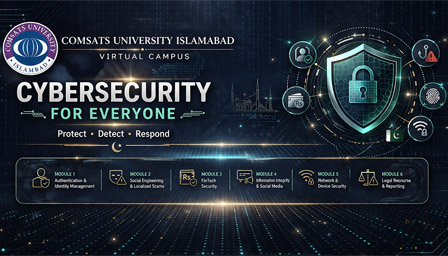
Cybersecurity Essentials: Protecting Yourself and Your Community Online
COMSATSCybersecurity Essentials: Protecting Yourself and Your Community Online
Course overview
Pakistan’s digital life now runs through WhatsApp groups, mobile wallets, online classrooms, and marketplace ads. The same channels that help a student in Abbottabad pay fees or a shopkeeper in Karachi receive payments are used by fraudsters who impersonate banks, courier services, employers, and even investigators. This course gives you practical, non-technical habits to protect yourself and the people who share your phone, home Wi-Fi, or family wallet.
What you will learn
- Explain confidentiality, integrity, and availability using local examples (CNIC photos, wallet PINs, exam portals).
- Recognise phishing, smishing, vishing, and malware lures common on Pakistani mobile networks.
- Create unique passphrases and turn on multi-factor authentication for email and financial apps.
- Tighten privacy on WhatsApp, Facebook, Instagram, and TikTok, and reduce oversharing of identity documents.
- Respond to a suspected compromise: freeze funds, contain accounts, keep evidence, and report to NCCIA and your provider.
- Coach family members—especially children and elders—without jargon or blame.
Pakistan context
Examples include JazzCash and EasyPaisa OTP theft, fake FIA/NCCIA calls, OLX and Facebook Marketplace deposits, “customs duty” parcel SMS, job and visa processing fees, and risks of shared Android phones. Reporting guidance points to the National Cyber Crime Investigation Agency (helpline 1799, nccia.gov.pk and complaint.nccia.gov.pk), your bank or wallet’s official app, and PTA for some telecom issues. This is awareness training, not legal advice. Confirm live contact details on official websites because they can change.
Who should enrol
Students, parents, working professionals, shopkeepers, and older adults who use the internet in Pakistan. No prior cybersecurity background is required.
Open training videos
Embedded videos are from CISA’s Secure Our World series (United States government works, public domain). Each video page includes attribution and a link back to cisa.gov/secure-our-world/videos.